The museums, and which one to pick
If you have room for one museum, the choice is between the general collection and the science one, and they stand ten minutes apart.
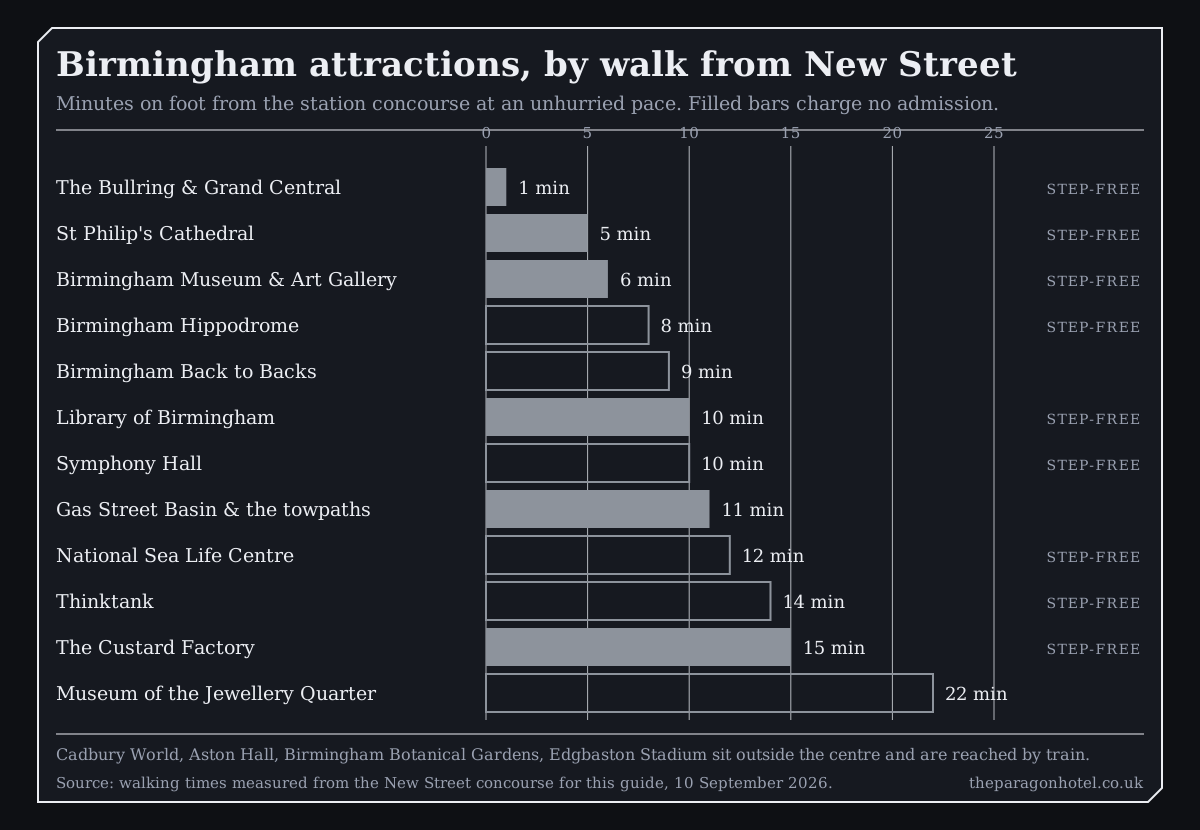
Birmingham Museum and Art Gallery in Chamberlain Square is the general answer, it charges nothing for entry, and it is the closer of the two at six minutes on foot.
It reopened after a long closure with the Pre-Raphaelite rooms, the Staffordshire Hoard, the Round Room and the Industrial Gallery back in use, along with a new family gallery.
Which individual spaces are open moves about while the building is worked on, so the museum's own listings settle that question best.
Thinktank at Millennium Point is the other case, and it charges admission. Four floors of galleries, a planetarium and an outdoor science garden sit around the city's industrial collection, including working steam engines and a Spitfire built at Castle Bromwich. All three of them have a page of their own here.
Free things to do in Birmingham
The free things to do in Birmingham are unusually good for a city of this size.
The Museum and Art Gallery charges nothing, and neither does the Library of Birmingham, whose rooftop garden gives you the best free view of the centre. St Philip's Cathedral holds four Burne-Jones windows commissioned for the building.
The canals are the other free asset, and the one visitors consistently underuse. Gas Street Basin is where the network meets, and the towpath from there runs level and traffic-free out through Brindleyplace.
Follow it the other way and you reach Digbeth, the Custard Factory and the murals around the film studios.
Strung together, those five stops make a full day with no admission charge anywhere in it. Cathedral, museum, library roof, towpath and Custard Factory run roughly west and then south-east, and no leg between any two of them runs longer than fifteen minutes on foot from the one before it.
The Bullring belongs on the same list, for a reason that has little to do with shopping.
It is built directly over the platforms, the markets sit immediately south of it, and the disc-clad Selfridges building is the one piece of Birmingham architecture most people can picture before they arrive.
What to do in Birmingham indoors
Thinktank at Millennium Point is the strongest wet-weather choice, with four floors of galleries, a planetarium and Birmingham's industrial collection. The Museum of the Jewellery Quarter is quieter and stranger: a working workshop closed in 1981 and left with its benches, tools and half-finished work exactly where they were last put.
For an afternoon that never goes outdoors, the station connects directly into Grand Central and the Bullring, and the markets sit immediately south. The Back to Backs on Hurst Street runs timed guided tours through four restored homes, each furnished for a different decade, which is the closest the city has to a walkable time series.
The Sea Life Centre at Brindleyplace is the third indoor option and the most reliable one with children, since a 360-degree ocean tunnel holds attention in a way a gallery cannot.
It sits on the canal twelve minutes west of the station, beside the arena and the ICC on Broad Street.
Theatres, concerts and the arena
Three buildings carry almost the whole of the evening programme between them, and all three can be walked to.
The Birmingham Hippodrome in Southside has 1,935 seats and is the busiest single theatre anywhere in the United Kingdom by attendance, with the home season of Birmingham Royal Ballet in it.
Symphony Hall sits inside the ICC on Broad Street, ten minutes from the platforms, and is regularly rated among the best-sounding concert halls in Europe.
The city-centre arena on King Edwards Road takes the touring shows, holds around 15,800 people, and opened back in 1991 as the National Indoor Arena.
That last detail explains a search problem. The arena has carried four names since it opened and is currently the Utilita Arena, so tickets, directions and old reviews are scattered across all of them. The building has not moved, and the walk from New Street is the same ten minutes it always was.
The canals, and walking the city
Birmingham's towpaths are a transport network you can still use, and they change how the centre reads.
Gas Street Basin is the junction, eleven minutes from the station, and from there the water runs west under Broad Street towards Brindleyplace and east down the slope towards Digbeth and the studios.
Walking west puts the arena, the ICC, Symphony Hall and the Sea Life Centre on one level route with no road crossings in it. Walking east takes you past the back of the markets into Digbeth, where the Custard Factory and the studios around it have collected most of the city's street art.
The advantage is less the scenery than the certainty. A towpath has no traffic lights, no kerbs and no through traffic, so a fifteen-minute estimate holds in a way a street-level one does not.
Walking routes across the centre are set out separately on this site, with the junctions named.
The Jewellery Quarter to visit
Twenty-two minutes north-west of New Street, and the furthest walkable entry on this page, the Jewellery Quarter is where the trade the city was built on still operates. The Museum of the Jewellery Quarter is the reason to make the walk, and it is unlike any other museum in Birmingham.
The workshop closed in 1981 and was left as its owners abandoned it, down to the benches, the tools and the unfinished work sitting on them.
Demonstrations run through the trade the quarter grew around. The area has its own tram stop and station, so the return leg need not be walked.
Step-free things to do in Birmingham
Step-free access is marked on every entry above, and the city centre performs well. The Museum and Art Gallery, Thinktank, the library, the Sea Life Centre, the Hippodrome, Symphony Hall and the Bullring are all navigable without stairs.
The Back to Backs is the clear exception, because the houses have deliberately not been altered.
The harder part is rarely the venue itself. It is the route between the station and the door, where a dropped kerb, a working lift or a level crossing point decides whether a plan holds.
Those journeys are covered separately, measured from New Street to the venues on this site.
Two routes are worth knowing before you arrive. The Bullring and Grand Central are reached from the platforms by lift without going outside, and the towpath west from Gas Street Basin is level for its whole length, which makes the arena and the Sea Life Centre reachable without a single step.
Four entries are listed as partial: the Museum of the Jewellery Quarter, the towpaths at Gas Street Basin, Aston Hall and the Botanical Gardens.
Some of each is reachable and some is not. Step-free routes across the city set out which entrances work, and the venues hold the current position on lifts.
Birmingham attractions with children
Three of the Birmingham attractions here are built for children, and they happen to spread neatly across the map.
Thinktank has the planetarium and the science garden, the Sea Life Centre has the ocean tunnel, and Cadbury World at Bournville is the half-day that needs a train to reach it.
The free option is better than it sounds. The Museum and Art Gallery's family gallery costs nothing, the library has space to sit and a roof to look out from, and the markets south of the Bullring are the kind of loud, busy place that fills twenty minutes without anybody planning it.
The grounds, and cricket at Edgbaston
Sport is the other reason people come, and the grounds are not in the centre.
Villa Park at Aston holds 43,205 and is about five minutes on foot from Witton, though the north stand is closed for the whole of the 2026/27 season, which cuts the working capacity to 36,887.
St Andrew's, renamed St Andrew's @ Knighthead Park in 2024, holds 29,409 in Bordesley, and The Hawthorns at West Bromwich is the only ground in the English professional leagues with its own tram stop. Edgbaston, founded in 1882, is England's fourth-largest cricket ground at roughly 25,000 seats, after Lord's, Old Trafford and The Oval.
Eating between the Birmingham attractions
The distances here are short enough that lunch is mostly a question of where you already are.
Southside, behind the Hippodrome, puts the Chinese Quarter and the Arcadian courtyard within two minutes of a theatre seat, which is why pre-theatre menus in that quarter are timed so tightly around curtain-up.
Digbeth handles the informal end, with the street-food halls around the Custard Factory, and the markets south of the Bullring are cheaper again.
The Balti Triangle, out through Sparkbrook and Balsall Heath, is a taxi ride and a separate evening altogether. Where to eat, by district covers all four of them.
Worth the trip out of the centre
Four entries are not walkable and are best planned as a half-day of their own.
Cadbury World sits at Bournville, about fifteen minutes by train, on the model village the Cadbury family built around the works. The Botanical Gardens are in Edgbaston, and Edgbaston Stadium is a separate trip again.
Aston Hall is the fourth, and the most surprising of them. A Jacobean mansion built between 1618 and 1635 stands in its own park a short walk from Villa Park, which means a match and a country house can be one afternoon. It opens Friday to Sunday, so the day matters here.
The Botanical Gardens repay the journey for one reason. Four Victorian glasshouses run in sequence from tropical to arid, and the fifteen acres around them were laid out in the 1830s and have changed remarkably little since, which is unusual for a garden of that age so close to a city centre.
Two days in Birmingham, in order
A workable first day stays north and west of the station. Cathedral, then the Museum and Art Gallery, then Centenary Square and the library roof, then down to Gas Street Basin and along the towpath to Brindleyplace for the arena, the ICC and the Sea Life Centre if children are along.
The second day goes east and south. Moor Street to Digbeth for the Custard Factory and the murals, back through the markets and the Bullring, then Hurst Street for a timed tour of the Back to Backs, and the Hippodrome in the evening if something in the programme suits you.
That leaves Thinktank and the Jewellery Quarter as the swaps. Either can replace an afternoon without breaking the shape of the two days, and a third day is what Cadbury World, the Botanical Gardens or a fixture at one of the grounds actually needs if it is to be done properly.
What a day of it costs
Six of the sixteen entries charge nothing, which is the figure that shapes a budget here.
The free things to do in Birmingham carry a full day on their own, so admission becomes a choice about Thinktank, the Sea Life Centre, the Back to Backs or one of the sites outside the centre.
Travel is the other line, and it is a small one. Twelve of the sixteen are inside a twenty-two-minute walk, four sit on the rail network, and driving in is the expensive option: everything inside the A4540 Middleway ring road is in the Clean Air Zone, which runs around the clock. Arriving, and what the charge is.

_-_panoramio.jpg)